
There’s growing noise in clinical programming circles. Questions like “Will AI replace clinical programmers?” or “Will R automation eliminate manual TFL programming?” are becoming more common. But these questions miss the point.
AI is not replacing SAS/R developers. It is expanding what one programmer can do, compressing timelines, and raising expectations across biostatistics, regulatory, technical, and delivery dimensions. In clinical trials, where precision, traceability, and reproducibility are non-negotiable, this shift is even more profound for the Biostatistics and Statistical Programming functions.
The evolution of the role can be understood through a familiar lifecycle:
- Understand
- Design
- Generate
- Validate
- Deliver
AI introduces leverage at each stage, but it also raises the bar for judgment and accountability.
Understanding has traditionally been one of the most time-consuming parts of clinical programming, requiring careful interpretation of protocols, SAPs, TFL shells, and dataset specifications. AI transforms this by turning unstructured documents into structured intelligence. Instead of manually parsing dense text, programmers can extract endpoints, populations, and derivations more efficiently and align them to standards like CDISC ARS. This allows programmers to move beyond decoding requirements and focus on challenging assumptions and refining logic earlier.
Design becomes even more critical in this new model. Clinical programming has never been just about writing code; it has always involved structuring derivations, ensuring traceability, and maintaining auditability. AI accelerates the creation of draft logic and dataset structures, but it does not replace judgment. Programmers are still responsible for ensuring that logic is compliant, consistent, and scalable, with AI acting as a thought partner rather than a decision maker.
Generation is the phase where the most visible transformation occurs. With domain-aware tools such as the AI Code Generator within TFL Designer, code generation becomes metadata-driven and context-aware, producing SAS or R code aligned to study requirements in seconds. At Clymb Clinical, this shift is already improving turnaround times, consistency, and collaboration. The programmer’s role is evolving from code author to orchestrator, guiding and shaping output rather than writing it line by line.
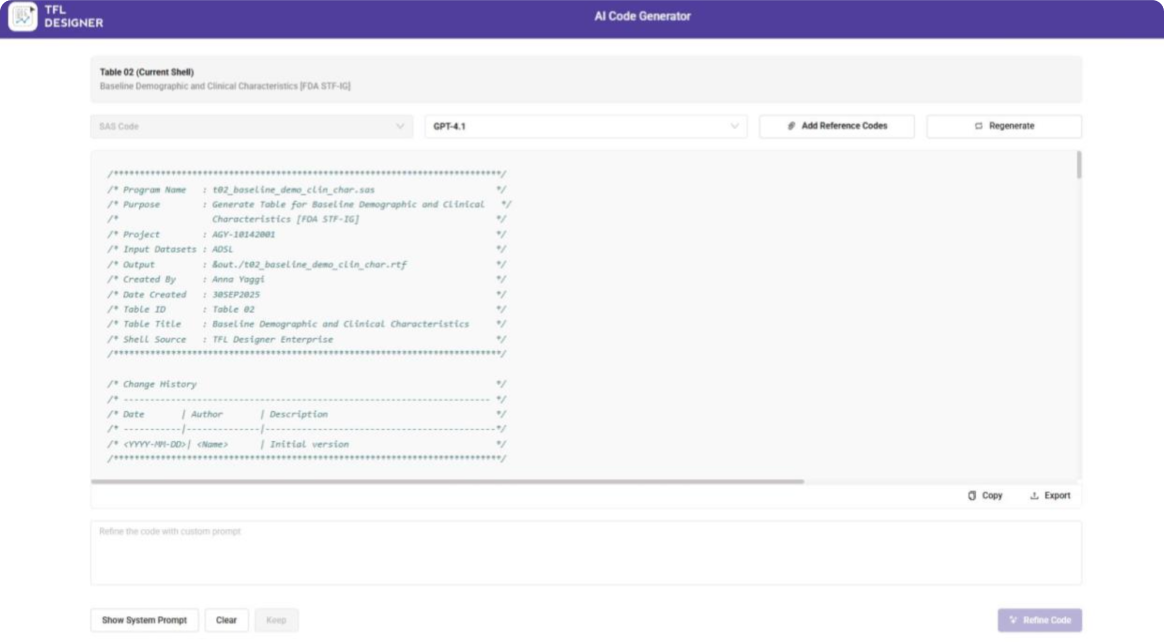
Figure: AI assisted SAS code generation using ARS and analysis display metadata
Validation and Governance, however, become even more critical. AI introduces a new risk: outputs that look correct but are not. Code may run successfully yet still misinterpret endpoints or miss edge cases. In a regulated environment, this is a compliance risk. The responsibility for ensuring accuracy, traceability, and reproducibility remains firmly with the programmer, making validation a central discipline rather than a final step.
Delivery is also transformed. Faster generation enables quicker iteration, earlier feedback from statisticians, and reduced rework. But with speed comes higher expectations. Delivery is no longer just about meeting timelines; it is about delivering precision at speed, where quality becomes the primary differentiator.
This shift redefines the role of the clinical programmer. It is no longer limited to executing specifications. Biostatisticians and Statistical Programmers are now configuring metadata, interacting with AI-driven systems, and dynamically generating and validating outputs. Tools like AI Code Generator make it possible to prototype quickly and automate repetitive tasks, but they also require deeper understanding. Using AI without understanding its output introduces risk.
Being an AI-native clinical programmer is not about using tools; it is about evolving how work is approached. It requires stronger fundamentals in CDISC standards, statistical reasoning, and regulatory expectations, along with a broader role in design and decision-making. Most importantly, it demands maintaining a higher quality bar even as output increases.
AI has not simplified clinical programming. It has made it more powerful and more demanding.
With tools like AI Code Generator within TFL Designer, we are moving toward a world where code is generated, logic is structured, and outputs are accelerated. But responsibility still sits with the Biostatistician and Statistical Programmer.
Not just to generate code, but to ensure it is correct, compliant, and defensible.
For more info please contact info@clymbclinical.com
VP of Engineering and AI Solutions